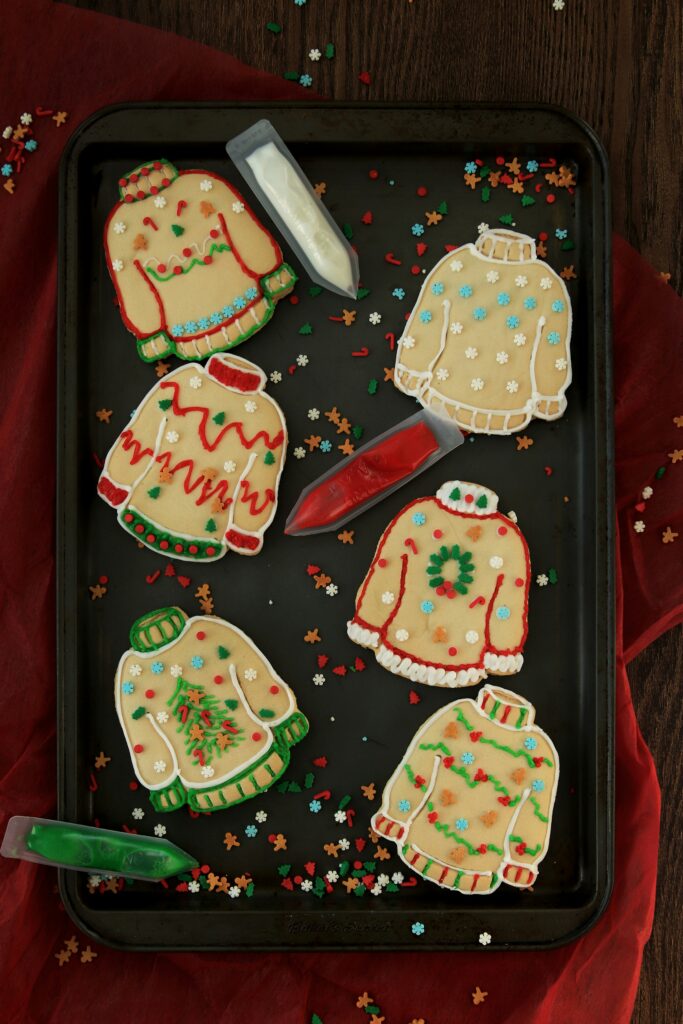
Sugar cookies are more than just sweet treats; they’re blank canvases waiting for your personal touch.
Whether you’re a seasoned baker or just grabbing some icing with the kids, decorating sugar cookies is one of the easiest ways to turn dessert into art.
In this post, you’ll find 7 fun and creative decorating ideas that don’t require fancy tools or pro-level skills. From marbling to stenciling, these tricks will make your cookies look bakery-worthy in no time!
Basic Tools & Icing You’ll Need
Before you dive into decorating, here’s a quick list of essentials to set you up for success. Most of these are easy to find and beginner-friendly.
- Piping bags or zip-top bags
For outlining and flooding cookies with icing. Zip-top bags work great in a pinch—just snip the corner! - Small round piping tips (like #1–#3)
Helps you control the flow of icing for fine lines, lettering, and detailed designs. - Gel food coloring
Provides vibrant colors without thinning your icing like liquid food coloring would. - Royal icing (soft and stiff peaks)
The MVP of cookie decorating. Stiff icing is for outlines and details; softer icing is for flooding. - Toothpicks or scribe tools
Used to pop air bubbles, drag icing for marbling, or fix tiny mistakes. - Optional: edible markers
Great for drawing fun designs or adding small accents after the icing has dried. - Optional: sprinkles and sanding sugar
Adds color, texture, and instant charm—perfect for borders and accents. - Optional: cookie stencils
For clean, repeatable patterns using royal icing or airbrushing (if you’re feeling fancy).
7 Creative Decorating Ideas
Let’s roll up those sleeves and bring some sugar cookie magic to life.
These 7 decorating techniques are simple to learn, wildly fun, and make your cookies look like they came straight out of a bakery display case.
1. Classic Royal Icing Flooding
This is the foundation of fancy cookie decorating. Start by piping a border around your cookie using thick royal icing. This outline acts like a dam to hold the “flood” icing in place.
Once the border is set slightly, fill the center with thinner, more fluid royal icing. Use a toothpick or scribe tool to push the icing into corners and smooth it out.
Tap the cookie gently to level the surface and pop any bubbles.
Let it dry completely before adding layers or details. Flooded cookies are perfect for themed sets like Christmas trees, pumpkins, or baby onesies. Clean, polished, and ready for extra flair.
2. Wet-on-Wet Marbling
This technique works while your flooded base is still wet, so timing is everything. Pipe dots, lines, or hearts onto the wet icing, then drag a toothpick through them to swirl and blend.
For hearts, try placing evenly spaced dots, then drag a toothpick down through the center of each one. For chevrons or swirls, alternate colored lines and swipe through them horizontally.
Go for color combos like pink and white for Valentine’s Day, or teal and gold for a trendy twist. The results look super impressive, but the method is surprisingly simple.
3. Stenciling with Royal Icing
Stenciling gives you clean, crisp designs that look like they took hours, when they actually take minutes. Place a cookie stencil over your fully dried icing base.
Then spread thick royal icing over the stencil using an offset spatula or scraper.
Hold the stencil steady while scraping for the best results. Carefully lift the stencil straight up, and don’t drag it or you’ll smear the design.
Stenciled cookies are perfect for weddings, baby showers, or any time you want a little elegance without the stress of hand-piping every detail.
4. Watercolor Cookies
Once your base icing is completely dry, it’s time to break out your inner artist. Mix a drop of gel food coloring with a tiny bit of clear alcohol (like vodka or lemon extract) to make edible paint.
Why alcohol? It evaporates fast and doesn’t soften the icing.
Use a clean paintbrush to add soft brushstrokes, blend colors, or create abstract art. This technique works beautifully for florals, ombré designs, and trendy “painted” cookies.
Just remember, less is more. Watercolor cookies have a delicate, artsy vibe, so don’t overwork the brush.
5. Fondant Cutouts and Impressions
If you prefer to skip piping altogether, fondant is your best friend. Roll it out thin, then use the same cookie cutter shape as your baked cookie.
Attach the fondant to the cookie using a swipe of corn syrup or edible glue.
Want to get fancy? Use embossing mats, textured rolling pins, or cookie stamps before cutting out your fondant shapes. It creates a clean, professional look that’s surprisingly easy.
Fondant is especially great for beginners, kids, or large batches because of its shorter drying time and less mess.
6. Edible Markers & Hand-Drawn Details
Once your royal icing has fully dried, food-safe markers let you draw directly onto the cookie. Think of them as edible Sharpies.
You can doodle faces, add cute messages, draw outlines, or even mimic cartoon characters. It’s a great option for kids’ birthday parties, classroom treats, or just adding a personal touch.
If you’re nervous about freehand drawing, lightly sketch the design with a toothpick first. Then trace over it with the marker. Simple and effective.
7. Sprinkle-Dipped Edges & Accents
Want to add flair without much fuss? Use sprinkles! One easy way is to dip the still-wet edges of flooded cookies into a bowl of sprinkles, sanding sugar, or crushed candy.
You can also pipe a border and dip just that. The result is eye-catching and adds a satisfying crunch.
Try red and green for Christmas, rainbow for birthdays, or gold sugar for a chic twist. It’s low effort, high reward.
Pro Decorating Tips for Beginners
Decorating sugar cookies isn’t about perfection, but it’s about patience, play, and a bit of practice.
Even the pros started with wobbly lines and air bubbles. These tips will help you skip the biggest beginner frustrations and enjoy the process from start to finish.
Keep Icing at the Right Consistency
Icing consistency can make or break your cookie design. Too thick, and it’s hard to spread. Too thin, and it runs off the edges faster than you can say “oops.”
For outlining, your icing should be thick enough to hold its shape—think toothpaste texture. For flooding, you want it thinner, more like honey that slowly smooths itself out.
A simple test: drag a spoon through the icing and count how long it takes to smooth over. Around 10 seconds means it’s perfect for flooding.
If it disappears too fast, add powdered sugar. If it takes forever, stir in a few drops of water. A few tweaks make all the difference.
Practice Piping on Parchment First
Before decorating your first cookie, grab a sheet of parchment paper and practice. It’s like warming up before a big game.
Try piping straight lines, dots, and outlines. You’ll get a feel for how much pressure to apply and how the icing flows.
The best part? You can scrape it off, refill your bag, and go again with no cookies wasted. It’s an easy way to build muscle memory so your first real batch looks smoother and more confident.
Let Layers Dry Before Adding More Detail
It’s tempting to jump right into the next step, but patience is your secret weapon. Let your base layer dry completely before adding new designs or colors.
Otherwise, the icing can bleed or cave in, and your masterpiece might look more like a tie-dye accident.
If you’re short on time, use a small fan or food dehydrator on low speed to speed things up.
Just avoid humid rooms because it’ll make the drying process longer. Once the surface feels firm to the touch, you’re good to go for your next layer.
Don’t Worry About Perfection—Have Fun With It!
Every cookie tells a story. Maybe one’s got a wonky smile or a slightly uneven edge, so what? That’s part of the charm. Remember, these are cookies, not competition entries.
The more you decorate, the better you’ll get, and the more fun you’ll have along the way.
Play with colors, experiment with designs, and embrace the happy accidents. The real goal is to enjoy the process (and maybe sneak a cookie or two while you’re at it).
Storage & Gifting Ideas
Once your sugar cookies are beautifully decorated, the last thing you want is to smudge all that hard work. Let the icing dry completely, preferably overnight, before storing or packaging.
Stack them only if they’re totally dry, and even then, use parchment or wax paper between layers to avoid sticking or damage.
For storage, airtight containers work best, and if you’re planning to keep them longer than a week, consider freezing them in single layers with parchment in between; just be sure to let them come to room temperature in the container before opening to avoid condensation ruining the icing.
When it comes to gifting, presentation matters. Slip each cookie into a clear cello bag and tie it off with a ribbon or twine for an instantly polished look.
You can also use cookie boxes with windows, bakery-style treat boxes, or even mason jars for smaller cookies.
Add a cute handwritten tag or printed label to make it personal—”baked with love” never goes out of style.
Decorated sugar cookies make fantastic gifts for birthdays, holidays, baby showers, and party favors, and because they hold up well when packaged correctly, you can prep them a few days in advance without stress.
Final Thoughts
Decorating sugar cookies doesn’t have to be complicated. It just takes a little curiosity and a steady hand. Pick one technique, give it a shot, and don’t stress if it’s not bakery-perfect.
The fun is in the doing. Let your creativity lead, and remember: even the messiest cookie still tastes amazing!
FAQs
Can I freeze decorated sugar cookies?
Yes, you can! Once the icing is completely dry, place cookies in a single layer between sheets of parchment paper and store them in an airtight container.
When thawing, leave the container closed until the cookies reach room temperature to prevent condensation from ruining the icing.
What icing works best for beginners?
Royal icing is the go-to for most cookie decorators, especially beginners. It dries smooth and hard, making it perfect for layering and detail work.
Start with a simple recipe using meringue powder because it’s more forgiving and easier to manage.
How long should the icing dry before packaging?
At least 8–12 hours is ideal. If you’re in a rush, give them a solid overnight rest in front of a fan or in a cool, dry spot.
Make sure they’re fully set before stacking or bagging to avoid dents, smears, or sticking.
Can I use regular food coloring instead of gel?
You can, but it’s not recommended. Liquid food coloring can thin out your icing too much, making it harder to control.
Gel food coloring is more concentrated, so you get bold colors without messing up your icing consistency.

Hi, I’m Sorenna Blythe, the baker and writer behind Mix Whisk Bake. I share simple, reliable recipes and honest kitchen moments to help home bakers bake with confidence and joy. When I’m not testing new treats, you’ll find me sipping coffee and dreaming up my next bake.