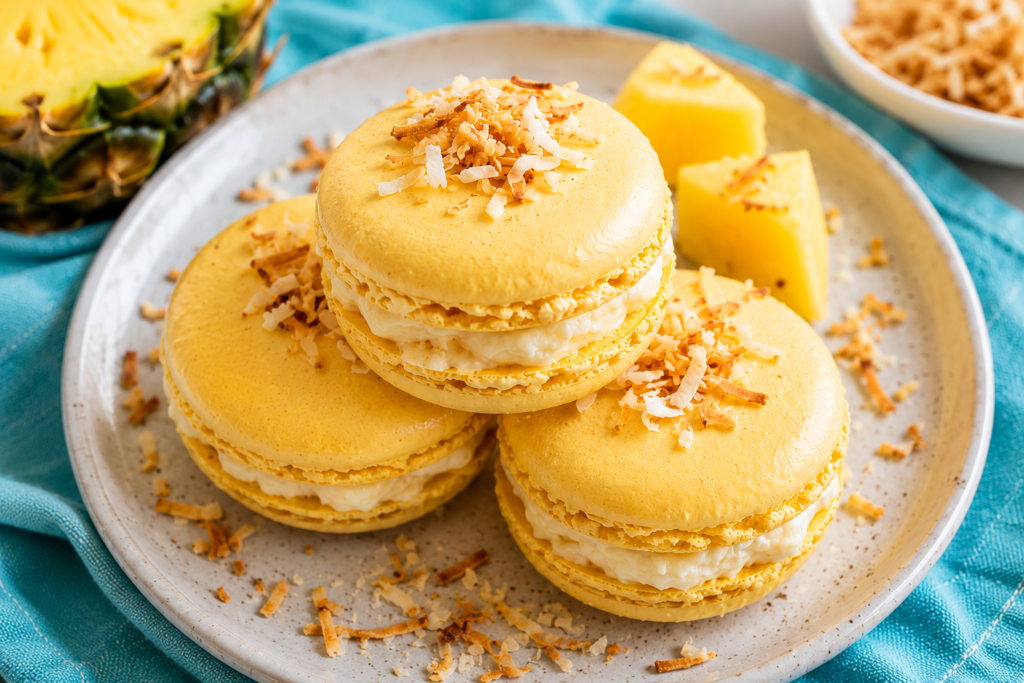
If you love tropical desserts, these Coconut Pineapple Macarons are a treat you won’t want to miss.
Crisp on the outside, soft and chewy in the center, they combine sweet coconut and juicy pineapple flavors in every bite.
Inspired by classic island desserts, these macarons bring a little taste of the tropics to your kitchen.
They’re bright, refreshing, and perfect for warm-weather gatherings, birthday celebrations, baby showers, or any occasion that calls for something special.
Don’t let macarons intimidate you.
This recipe walks you through each step with simple instructions and helpful tips, making it easier to create beautiful, bakery-style macarons at home.
Grab your ingredients and get ready to bake a dessert that’s as fun to make as it is to share.
Why You’ll Love These Coconut Pineapple Macarons
- Sweet Tropical Flavor Combination – Coconut and pineapple create a bright, refreshing pairing that tastes like a tropical getaway in dessert form.
- Light, Crisp Shells with Chewy Centers – Each macaron has a delicate outer shell and a soft, chewy interior for the perfect texture contrast.
- Creamy Coconut Filling and Fruity Pineapple Notes – The rich coconut filling is balanced by sweet pineapple flavor in every bite.
- Impressive Bakery-Style Dessert Made at Home – These beautiful macarons look professional while being completely achievable in your own kitchen.
- Naturally Elegant and Gift-Worthy – Their delicate appearance makes them perfect for parties, celebrations, and homemade gifts.
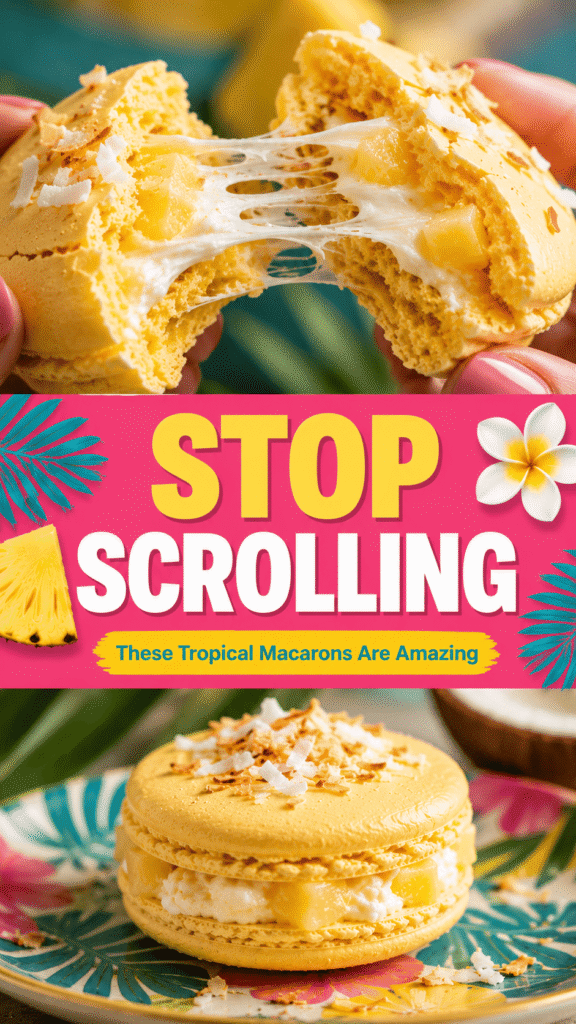
What Are Coconut Pineapple Macarons?
Coconut Pineapple Macarons are a tropical variation of classic French macarons, delicate sandwich cookies made with almond flour, egg whites, and sugar.
French macarons are known for their smooth tops, ruffled edges called “feet,” and soft, chewy centers that make them one of the most recognizable pastries in the world.
If you’re new to macarons, it’s easy to confuse them with macaroons, but they are completely different desserts.
Macarons are light sandwich cookies made with almond flour and filled with buttercream, ganache, or jam, while macaroons are denser coconut-based cookies that are usually dropped onto a baking sheet and baked without a filling.
In this recipe, coconut and pineapple bring a fun tropical twist to the traditional French treat.
The coconut adds a rich, slightly nutty sweetness that pairs beautifully with the bright, fruity flavor of pineapple.
Together, these flavors create a combination that feels fresh, sunny, and perfect for warm-weather celebrations.
The contrast between the creamy coconut filling and the sweet pineapple notes makes every bite taste balanced rather than overly sweet.
Texture is one of the reasons macarons are so special.
The shells have a delicate crispness when you first bite into them, followed by a soft and slightly chewy interior that melts in your mouth.
The filling adds a smooth, creamy layer that brings everything together and makes the cookies even more enjoyable after they have matured in the refrigerator.
The result is an elegant dessert with tropical flavor, beautiful texture, and a bakery-style appearance that feels impressive while still being achievable for home bakers.
Ingredients You’ll Need
For the Macaron Shells
- 1 cup (100g) finely ground almond flour – Provides the signature texture and structure of the macaron shells.
- 1¾ cups (200g) powdered sugar – Sweetens the shells and helps create a smooth batter.
- 3 large egg whites (about 100g), room temperature – Whip into a stable meringue that gives the macarons their light texture.
- ¼ cup (50g) granulated sugar – Stabilizes the meringue and helps create glossy peaks.
- 2–3 drops yellow food coloring (optional) – Adds a tropical-inspired color to the shells.
For the Coconut Pineapple Filling
- ½ cup (113g) unsalted butter, softened – Creates a rich and creamy buttercream base.
- 1½ cups (180g) powdered sugar – Sweetens and thickens the filling.
- 2 tablespoons coconut cream – Adds smooth texture and rich coconut flavor.
- 3 tablespoons pineapple preserves or pineapple curd – Brings sweet, fruity pineapple flavor to the filling.
- 1 teaspoon vanilla extract – Enhances the overall flavor and sweetness.
- 2 tablespoons finely shredded sweetened coconut (optional) – Adds extra coconut flavor and a bit of texture.
Kitchen Tools Required
- Stand Mixer or Hand Mixer – Used to whip the egg whites into a stable, glossy meringue with stiff peaks.
- Mixing Bowls – You’ll need separate bowls for the dry ingredients and the meringue.
- Fine Mesh Sieve – Helps remove lumps from the almond flour and powdered sugar for smoother macaron shells.
- Silicone Spatula – Perfect for folding the batter during the macaronage process without deflating the meringue too quickly.
- Piping Bags – Makes it easy to pipe uniform macaron shells and neatly fill the finished cookies.
- Round Piping Tip – Creates smooth, evenly sized circles for professional-looking macarons.
- Baking Sheets – Provides a sturdy surface for baking the macaron shells evenly.
- Parchment Paper or Silicone Mats – Prevents sticking and helps the shells release cleanly after baking.
- Kitchen Scale – Highly recommended for accurately measuring ingredients, which is key to successful macarons.
How to Make Coconut Pineapple Macarons
Step 1: Prepare the Dry Ingredients
Begin by sifting the almond flour and powdered sugar together through a fine mesh sieve into a large mixing bowl.
Sifting helps break up clumps and creates a finer mixture, which is important for smooth macaron shells.
If you notice larger pieces of almond flour left behind in the sieve, discard them rather than forcing them through.
Taking a few extra minutes here can make a noticeable difference in the final appearance of your macarons.
Set the dry mixture aside while you prepare the meringue.
Step 2: Make the Meringue
Place the room-temperature egg whites into a clean, dry mixing bowl.
Using a stand mixer or hand mixer, beat the egg whites on medium speed until they become foamy.
Slowly add the granulated sugar, a little at a time, while continuing to mix.
Adding the sugar gradually helps create a stable meringue with better structure.
Continue beating until the mixture becomes thick, glossy, and holds stiff peaks.
A stiff peak means the meringue stands straight up when you lift the whisk without folding over.
If using food coloring, add it during the final moments of mixing so the color is evenly distributed.
Step 3: Fold the Batter (Macaronage)
Add the sifted almond flour and powdered sugar mixture to the meringue.
Using a silicone spatula, gently fold the ingredients together by scraping around the bowl and cutting through the center of the batter.
At first, the mixture will seem thick and lumpy.
As you continue folding, the batter will gradually become smoother and more fluid.
The goal is a consistency that slowly flows from the spatula like lava.
When dropped back into the bowl, the batter should form ribbons that disappear into the surface within about 20 to 30 seconds.
Take your time during this step because overmixed batter can spread too much, while undermixed batter can create uneven shells.
Step 4: Pipe the Macaron Shells
Transfer the finished batter into a piping bag fitted with a round piping tip.
Pipe evenly sized circles onto a baking sheet lined with parchment paper or a silicone baking mat.
Try to keep the piping bag straight above the baking sheet to help create round, uniform shells.
Leave a little space between each shell to allow for slight spreading.
Once all the batter has been piped, firmly tap the baking sheet against the counter several times.
This helps release trapped air bubbles that could cause cracks during baking.
If you see any visible bubbles on the surface, gently pop them with a toothpick.
Step 5: Rest the Shells
Allow the piped shells to sit at room temperature before baking.
During this resting period, the tops will dry slightly and form a thin skin.
This skin helps the macarons rise properly and develop their signature feet during baking.
Depending on the humidity in your kitchen, this can take anywhere from 30 to 60 minutes.
To test if they are ready, lightly touch the surface of a shell with a fingertip.
If no batter sticks to your finger, the shells are ready for the oven.
Step 6: Bake
Preheat your oven to 300°F (150°C).
Bake the macarons for 14 to 16 minutes, rotating the baking sheet halfway through if your oven heats unevenly.
The shells should rise and develop distinct feet around the bottom edges.
Properly baked macarons should feel set when lightly touched.
The tops should not wobble when gently nudged.
Allow the shells to cool completely on the baking sheet before attempting to remove them.
Trying to remove warm shells can cause them to stick or break.
Step 7: Prepare the Coconut Pineapple Filling
In a mixing bowl, beat the softened butter until smooth and creamy.
Gradually add the powdered sugar and continue mixing until light and fluffy.
Add the coconut cream and vanilla extract, then mix until fully combined.
Stir in the pineapple preserves or pineapple curd and continue beating until the filling is smooth.
If desired, mix in finely shredded coconut for extra flavor and texture.
If the filling seems too thick, add a small amount of coconut cream.
If it feels too soft, mix in a little more powdered sugar until it reaches a pipeable consistency.
Step 8: Assemble the Macarons
Match the cooled shells into pairs of similar size.
Transfer the filling to a piping bag or use a spoon to add a small amount to the flat side of one shell.
Pipe a generous but controlled amount of filling into the center.
Place the second shell on top and gently press until the filling spreads close to the edges.
Avoid pressing too hard to prevent cracking the delicate shells.
Repeat with the remaining macaron pairs.
Step 9: Mature the Macarons
Arrange the assembled macarons in an airtight container and refrigerate them for at least 24 hours.
While it may be tempting to eat them immediately, this resting period greatly improves the final texture.
During maturation, moisture from the filling slowly softens the inside of the shells while allowing the exterior to remain delicate.
The flavors also have time to blend together, creating a richer coconut and pineapple taste throughout each bite.
Before serving, allow the macarons to sit at room temperature for about 15 to 20 minutes.
This short wait helps the filling soften slightly and allows the tropical flavors to shine at their best.
Tips for Perfect Macarons Every Time
Weigh Ingredients Accurately
Macarons are one of those recipes where precision makes a big difference.
Using a kitchen scale is far more reliable than measuring cups because even small differences in ingredient amounts can affect the final result.
Too much almond flour can make the batter thick and difficult to work with.
Too much egg white can make the batter too loose and cause the shells to spread.
For the most consistent macarons, weigh every ingredient before you begin mixing.
Avoid Overmixing or Undermixing
The folding stage, often called macaronage, is one of the most important parts of the recipe.
An undermixed batter tends to be thick and may leave peaks on top of the piped shells instead of settling smoothly.
Overmixed batter becomes too runny and can spread excessively, leading to flat shells.
A properly mixed batter should flow slowly from the spatula and resemble thick lava.
If you’re unsure, stop and check the consistency frequently rather than rushing through the process.
With practice, recognizing the correct texture becomes much easier.
Properly Aged Egg Whites
Many bakers prefer using aged egg whites because they can create a more stable meringue.
Aging simply means separating the egg whites from the yolks and storing them in the refrigerator for about 24 hours before baking.
Before using them, allow the egg whites to come to room temperature.
Room-temperature egg whites generally whip more easily and can create better volume.
While fresh egg whites can still work, aged egg whites often provide more consistent results.
Monitor Humidity Levels
Humidity can have a surprisingly large impact on macarons.
High moisture in the air can make it difficult for the shells to dry properly during the resting stage.
If the shells do not develop a skin before baking, they are more likely to crack in the oven.
On very humid days, resting times may need to be longer than usual.
If possible, choose a dry day for baking macarons, especially when you’re still learning the process.
Use an Oven Thermometer
Many ovens run hotter or cooler than the temperature shown on the display.
Even a small temperature difference can affect how macarons rise and bake.
An inexpensive oven thermometer helps you verify the actual temperature inside your oven.
This allows you to make small adjustments if needed and can prevent issues such as browning, cracking, or underbaking.
Consistent oven temperature is one of the easiest ways to improve your macaron success rate.
Allow Sufficient Resting Time
Resting the piped shells before baking is an important step that should not be skipped.
During this time, the surface dries and forms a thin protective layer.
This layer encourages the macarons to rise upward and develop their signature feet instead of cracking across the top.
The exact resting time can vary depending on the temperature and humidity in your kitchen.
Rather than watching the clock, gently touch the top of a shell.
If it feels dry and no batter sticks to your finger, the macarons are ready to bake.
Patience during this step often leads to smoother, more professional-looking results.
Common Macaron Problems and Solutions
Cracked Shells
Cracked shells are one of the most common issues bakers encounter when making macarons.
This usually happens when the shells have not rested long enough before baking.
Without a dry surface, steam escapes through the top of the shell during baking, causing cracks to form.
Oven temperatures that are too high can also force the shells to expand too quickly.
Trapped air bubbles inside the batter may create weak spots that crack as the macarons rise.
To help prevent this problem, allow the shells to rest until the tops feel dry to the touch.
Always tap the baking tray firmly on the counter after piping to release trapped air.
Using an oven thermometer can also help ensure your macarons bake at the correct temperature.
Even if a few shells crack, don’t get discouraged.
Most macaron bakers experience this at some point, and small adjustments often solve the problem.
Hollow Macarons
Hollow macarons have a large empty space between the shell and the interior.
While they may still taste delicious, they are not ideal in terms of texture and appearance.
Several factors can contribute to hollow shells.
Overwhipped meringue can create too much air, which may collapse during baking.
Undermixed or overmixed batter can also affect how the shells develop in the oven.
Baking at the wrong temperature is another common cause.
To reduce the chances of hollow macarons, whip the meringue only until stiff peaks form.
Fold the batter carefully and stop once it reaches the proper flowing consistency.
Give the shells enough time to bake fully so the centers have a chance to set.
Making small adjustments and taking notes can help you identify what works best in your oven.
No Feet Formation
The ruffled edge at the bottom of a macaron is called the foot.
Feet are a sign that the shells expanded properly during baking.
If your macarons have no feet, the shells may not have developed a skin before going into the oven.
Insufficient resting time is one of the most common reasons this happens.
Runny batter caused by overmixing can also prevent proper foot formation.
Sometimes an oven that is too cool does not provide enough heat for the shells to rise correctly.
Allow the piped shells to rest until they feel dry on top before baking.
Pay close attention to batter consistency during the folding stage.
Checking your oven temperature with a thermometer can also improve results.
Once you find the right combination of resting time and baking temperature, consistent feet become much easier to achieve.
Lopsided Macarons
Lopsided macarons rise unevenly, creating shells that lean to one side.
This issue is often caused by uneven airflow inside the oven.
Strong hot spots can push the shells in one direction as they bake.
Uneven piping can also contribute to shells that do not rise evenly.
If the baking sheet is not sitting flat, the batter may spread more heavily on one side before baking begins.
To help prevent lopsided macarons, pipe the batter straight down rather than at an angle.
Make sure your baking trays are level before placing them in the oven.
Rotating the tray halfway through baking can sometimes help if your oven has uneven heat distribution.
A good macaron template can also help create evenly sized and shaped shells.
Remember that even imperfect macarons are still enjoyable to eat.
Every batch teaches you something new, and each attempt builds the confidence and experience needed for even better results next time.
Flavor Variations
- Toasted Coconut Macarons – Add toasted shredded coconut to the filling for a richer coconut flavor and a subtle nutty crunch.
- Pineapple Coconut Rum Macarons – Mix a small amount of rum extract into the filling to create a dessert inspired by classic tropical cocktails.
- Mango Coconut Macarons – Replace the pineapple preserves with mango preserves or mango curd for a sweet and fruity twist.
- Piña Colada Macarons – Combine coconut filling with pineapple flavor and a touch of rum extract for a fun take on the popular island drink.
- Tropical Citrus Macarons – Add lime, orange, or passion fruit zest to the filling for a bright, refreshing burst of tropical flavor.
Storage Instructions
Proper storage helps maintain the delicate texture and fresh tropical flavor of your Coconut Pineapple Macarons.
If you plan to enjoy them within a day, they can be stored in an airtight container at room temperature.
For the best quality, avoid placing them in direct sunlight or near sources of heat, as the filling can soften too much.
At room temperature, assembled macarons are generally best enjoyed within 24 hours.
Because these macarons contain a buttercream-based filling, refrigerator storage is the preferred option for longer freshness.
Place the macarons in a single layer or separate layers with parchment paper inside an airtight container.
This helps prevent excess moisture from affecting the shells while protecting them from absorbing odors from other foods in the refrigerator.
Stored properly, Coconut Pineapple Macarons will stay fresh in the refrigerator for up to 5 days.
Before serving, allow them to sit at room temperature for about 15 to 20 minutes.
This short resting time helps the filling soften slightly and allows the flavors to become more noticeable.
If you would like to store them for an even longer period, freezing is an excellent option.
Unfilled macaron shells can be frozen in an airtight container for up to 2 months.
Place parchment paper between layers to prevent the shells from sticking together or becoming damaged.
When ready to use, thaw the shells in the refrigerator before filling and assembling them.
Fully assembled macarons can also be frozen successfully.
Arrange them in a single layer until frozen solid, then transfer them to an airtight freezer-safe container.
This extra step helps protect their shape and prevents them from sticking together.
Frozen assembled macarons can be stored for up to 2 months.
To thaw, place them in the refrigerator overnight and allow them to come to room temperature before serving.
Make-Ahead Tips
Coconut Pineapple Macarons are an excellent dessert to prepare in advance, making them a great choice for parties, holidays, birthdays, and special events.
One of the easiest ways to save time is by preparing the macaron shells ahead of time.
Once the shells have completely cooled, place them in an airtight container and store them in the refrigerator for up to 5 days.
If you need even more flexibility, the shells can be frozen for up to 2 months without losing their texture.
Separating layers with parchment paper helps prevent cracking and keeps the shells looking their best.
The coconut pineapple filling can also be made ahead and stored separately.
Transfer the filling to an airtight container and refrigerate it for up to 4 days.
When you’re ready to use it, allow it to sit at room temperature for a short time until it becomes soft enough to pipe easily.
If needed, give it a quick stir to restore its smooth and creamy texture.
Keeping the shells and filling separate until closer to serving time can help maintain the delicate crispness of the shells.
For the freshest presentation, assemble the macarons one day before you plan to serve them.
This timing allows the shells and filling to mature together overnight, creating the ideal texture that macarons are known for.
During this resting period, the filling gently softens the inside of the shells while allowing the exterior to remain delicate and lightly crisp.
The flavors also have time to blend together, giving the coconut and pineapple notes a more balanced and developed taste.
If you’re preparing macarons for a special occasion, having the shells and filling ready ahead of time can make assembly quick, easy, and stress-free.
A little planning goes a long way and helps ensure you have beautiful, bakery-style macarons ready whenever you need them.
Serving Suggestions
- Summer Dessert Platters – Add these tropical macarons to a dessert spread alongside fresh fruit and other light treats for a colorful warm-weather presentation.
- Tropical-Themed Parties – Their coconut and pineapple flavors make them a perfect fit for island-inspired celebrations and summer gatherings.
- Bridal Showers and Baby Showers – Their elegant appearance and delicate flavor make them a beautiful addition to special occasions.
- Afternoon Tea Treats – Serve them with tea or coffee for a sweet, bite-sized dessert that feels both classic and special.
- Homemade Edible Gifts – Package them in decorative boxes or tins for a thoughtful homemade gift that friends and family will appreciate.
Final Thoughts
These Coconut Pineapple Macarons combine crisp shells, chewy centers, and a creamy tropical filling for a dessert that feels both elegant and fun.
If you’re making macarons for the first time, take your time and enjoy the process—each batch is a great opportunity to build your confidence and skills.
Once you’ve mastered this recipe, don’t be afraid to experiment with other tropical flavors like mango, passion fruit, or lime to create your own unique variations.
Be sure to save this recipe for future baking projects and share it with friends and family who love tropical desserts as much as you do.
FAQs
Can I use fresh pineapple?
Yes, but it should be cooked down first to remove excess moisture. Too much liquid can make the filling runny and affect the texture of the macarons.
Why did my macarons crack?
Cracked macarons are often caused by insufficient resting time, trapped air bubbles, or an oven that is too hot.
Can I make these without food coloring?
Absolutely. The food coloring is completely optional and does not affect the flavor or texture of the macarons.
How long do macarons last?
Stored in an airtight container in the refrigerator, macarons stay fresh for up to 5 days.
Can I freeze coconut pineapple macarons?
Yes. Both the shells and assembled macarons can be frozen for up to 2 months when stored in an airtight container.
What’s the best filling consistency?
The filling should be smooth, creamy, and firm enough to hold its shape when piped without being stiff or dry.
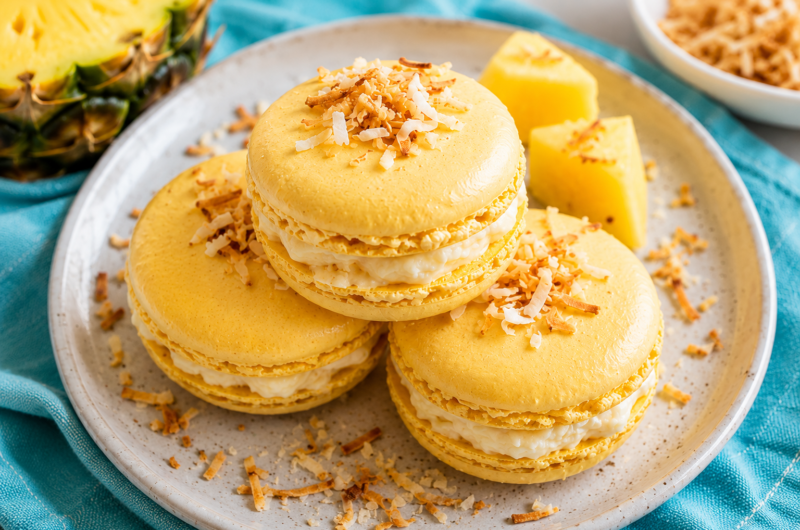
Delicate Coconut Pineapple Macarons Bursting with Tropical Flavor
Difficulty: Easy18
Macarons30
minutes16
minutes46
minutesCrisp coconut pineapple macarons with chewy centers and a creamy tropical filling made with coconut cream and pineapple preserves.
Ingredients
1 cup (100g) almond flour
1¾ cups (200g) powdered sugar, divided
3 large egg whites, room temperature
¼ cup (50g) granulated sugar
2–3 drops yellow food coloring (optional)
½ cup (113g) unsalted butter, softened
2 tablespoons coconut cream
3 tablespoons pineapple preserves or pineapple curd
1 teaspoon vanilla extract
2 tablespoons shredded coconut (optional)
Directions
- Sift the almond flour and 1¾ cups powdered sugar together.
- Beat the egg whites until foamy, then gradually add the granulated sugar and whip to stiff peaks. Add food coloring if desired.
- Fold the dry ingredients into the meringue until the batter flows slowly like lava.
- Pipe circles onto lined baking sheets and tap the trays to remove air bubbles.
- Let the shells rest for 30–60 minutes until dry to the touch.
- Bake at 300°F (150°C) for 14–16 minutes, then cool completely.
- Beat the butter, remaining powdered sugar, coconut cream, pineapple preserves, and vanilla until smooth. Stir in shredded coconut if using.
- Pipe the filling onto half the shells and sandwich with the remaining shells.
- Refrigerate for 24 hours before serving for the best texture and flavor.
Notes
- Weigh ingredients for the most consistent results.
- Allow the shells to rest fully before baking to help prevent cracks.
- Store macarons in the refrigerator for up to 5 days or freeze for up to 2 months.

Hi, I’m Sorenna Blythe, the baker and writer behind Mix Whisk Bake. I share simple, reliable recipes and honest kitchen moments to help home bakers bake with confidence and joy. When I’m not testing new treats, you’ll find me sipping coffee and dreaming up my next bake.